What is a self-adhesive sticker?
Introduction to Self-Adhesive Materials (Pressure-Sensitive Adhesives)
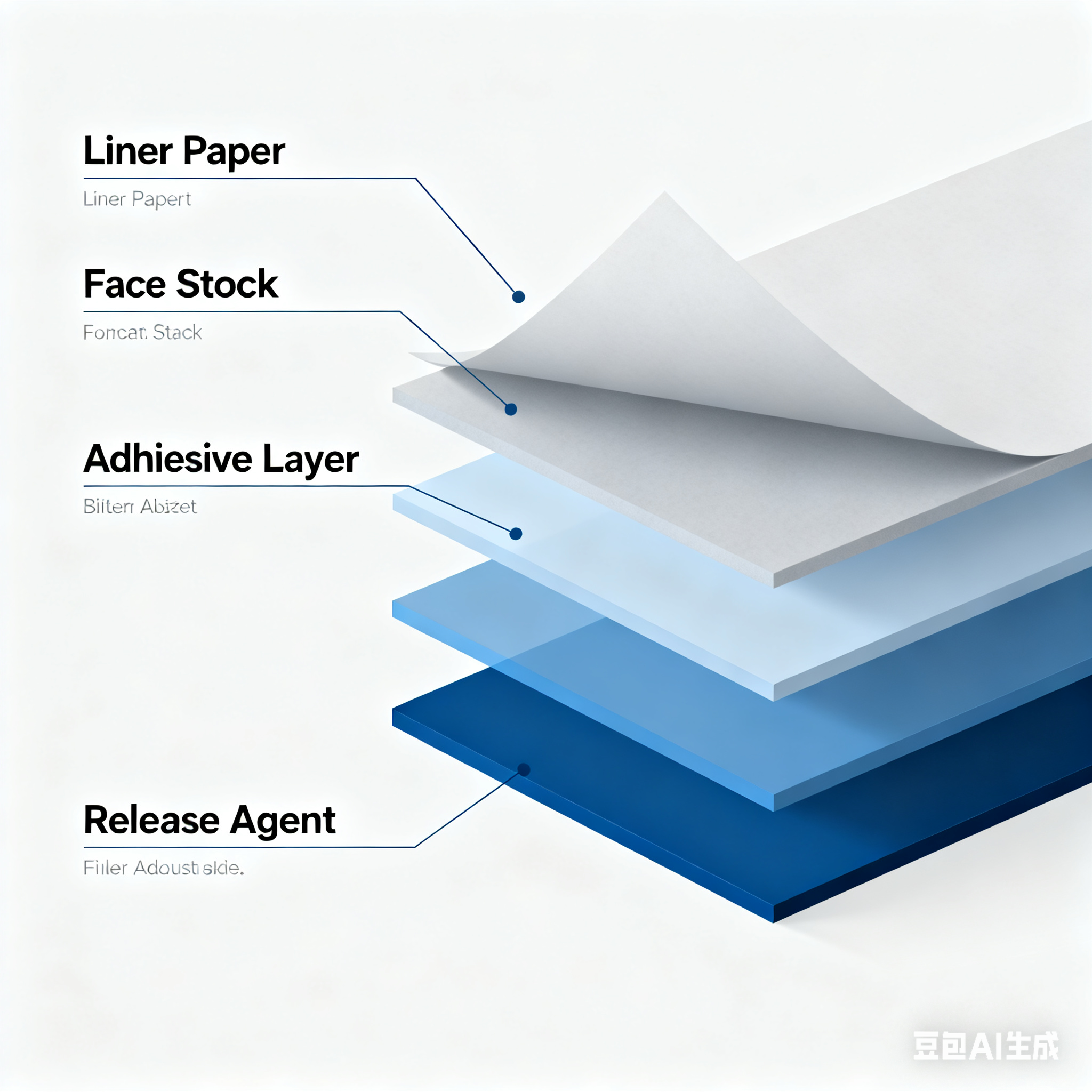
Self-adhesive materials, also known as pressure-sensitive adhesive (PSA) materials or label stocks, are composite structures. They consist of a face material coated with an adhesive on one side, which is then affixed to a release liner. The key characteristic is that they form a bond with a surface upon the application of light pressure, without the need for water, solvent, or heat activation.
The basic structure is a “sandwich” of three core components:
Face Stock (or Facestock): The top layer that carries the printed information and is the visible part of the label.
Adhesive: The sticky layer that bonds the face stock to the application surface.
Release Liner (or Backing Paper): The carrier sheet, coated with a silicone layer, that protects the adhesive until the moment of use and allows the label to be cleanly removed.
1. Face Stock
The face stock determines the label’s appearance, feel, and durability. It is broadly categorized into two types:
A. Paper-Based Face Stocks
Coated Paper:
Characteristics: Smooth, uniform surface with excellent printability. The most common and cost-effective option.
Applications: Product labels, shipping labels, food labels, office printer labels.
Uncoated Paper / Matte Paper:
Characteristics: Non-glossy, natural feel, good writability with pen or pencil.
Applications: Premium cosmetic labels, wine labels, labels requiring handwriting.
Specialty Papers:
Characteristics: Feature unique textures and appearances, such as leather, linen, or metallic finishes. Used to enhance brand perception.
Applications: Wine & spirit labels, high-end cosmetics, gifts, luxury packaging.
Direct Thermal & Thermal Transfer Papers:
Direct Thermal: Chemically coated paper that turns black when heated by a thermal printhead. No ribbon required. Common for receipts and shipping labels, but susceptible to fading over time.
Thermal Transfer: Smoother paper designed for use with a wax/resin ribbon. Produces highly durable, scratch and chemical-resistant text and barcodes.
Applications: Logistics, inventory management, barcodes, shipping labels.
B. Film-Based Face Stocks
Films are generally more durable, offering water, oil, chemical, and tear resistance.
Polypropylene (BOPP):
Characteristics: The most common film. Available in white, clear, and metallic finishes, in both glossy and matte. Strong, flexible, and cost-effective for a film.
Applications: Personal care products (shampoo, conditioner), electronics, outdoor labels.
Polyethylene (PE):
Characteristics: Very soft and flexible, can conform to curved and squeezable containers. Known as a “soft feel” film.
Applications: Bottles for lotions, shampoos, and household cleaners.
Polyvinyl Chloride (PVC):
Characteristics: Durable, flexible, and with good weather resistance. Available in various thicknesses and finishes (rigid, flexible, matte).
Applications: Industrial labels, drum labels, outdoor asset tags.
Polyester (PET):
Characteristics: Extremely durable, resistant to high temperatures, chemicals, and abrasion. Very strong and dimensionally stable.
Applications: Electronics labels (UL/CSA certified), automotive parts, battery labels, harsh environment applications.
Polyethylene (PE):
Characteristics: Very soft and flexible, can conform to curved and squeezable containers. Known as a “soft feel” film.
Applications: Bottles for lotions, shampoos, and household cleaners.
Vinyl (PVC):
Characteristics: Durable, flexible, and with good weather resistance. Available in various thicknesses and finishes (rigid, flexible, matte).
Applications: Industrial labels, drum labels, outdoor asset tags.
Polyester (PET):
Characteristics: Extremely durable, resistant to high temperatures, chemicals, and abrasion. Very strong and dimensionally stable.
Applications: Electronics labels (UL/CSA certified), automotive parts, battery labels, harsh environment applications.
2. Adhesive
Adhesives are selected based on the surface and performance requirements.
Permanent Adhesive:
Characteristics: Designed to create a strong, permanent bond. Attempting to remove the label will likely tear it or damage the surface.
Applications: Product branding, security labels, warranty seals.
Removable Adhesive:
Characteristics: Forms a temporary bond, allowing the label to be removed cleanly without leaving residue, typically for a short period (hours to days).
Applications: Promotional stickers, price-off tags, temporary name badges.
Ultra-Removable / Repositionable Adhesive:
Characteristics: Allows for multiple re-applications without losing adhesion. Commonly found on Post-it® notes.
Freezer-Grade Adhesive:
Characteristics: Specially formulated to remain adhered and functional in low-temperature and high-moisture environments.
Applications: Labels for frozen food packaging.
3. Release Liner
The liner protects the adhesive until use.
Glassine / Kraft Paper Liner:
Characteristics: Dense, super-calendered paper with high resistance to adhesive penetration. Economical and commonly used.
Polyester (PET) / Polypropylene (PP) Film Liner:
Characteristics: Extremely strong, dimensionally stable, and transparent. Used for high-speed automatic application and die-cutting processes.
Polycoated Paper Liner:
Characteristics: Paper liner with a PE coating, providing excellent moisture resistance and a very consistent release level.
How to Choose the Right Material
Selecting the correct self-adhesive material requires answering these key questions:
Surface: What are you sticking it to? (Plastic, glass, metal, wood, cardboard, curved, smooth, rough?)
Environment: What conditions will it face? (Indoor, outdoor, UV exposure, moisture, chemicals, extreme temperatures, abrasion?)
Lifespan: How long does it need to last? (Permanent, temporary for a few days, or several years outdoors?)
Application Method: How will it be applied? (By hand, with a high-speed automatic label applicator, or printed on a desktop printer?)
Finish & Aesthetics: What should it look and feel like? (Glossy, matte, transparent, premium textured, soft-touch?)
By systematically considering these factors—Surface, Environment, Lifespan, Application, and Finish—you can identify the perfect self-adhesive material for any project.